Kalium BLE Gateway
The Kalium has been discontinued and is no longer sold for new projects. This documentation remains available to support existing installations. For new projects or replacements, contact the Iongrade sales team.
The Kalium is a BLE communication gateway designed for beacon monitoring systems. It features the most modern IoT technology resources to deliver the best cost/benefit ratio in location and monitoring projects, allowing easy integration with a wide range of asset management and people, animal, and vehicle monitoring systems.
The hardware was designed to operate safely and reliably in the most diverse environmental conditions, with electronic circuits specially designed to protect the components against electrical discharges.
The Kalium is the root node of a mesh network formed by the Scandium detection antennas. It is the only device in the system that communicates with the server; the Scandium antennas only detect the beacons and report to the Kalium over the mesh network.
Overview
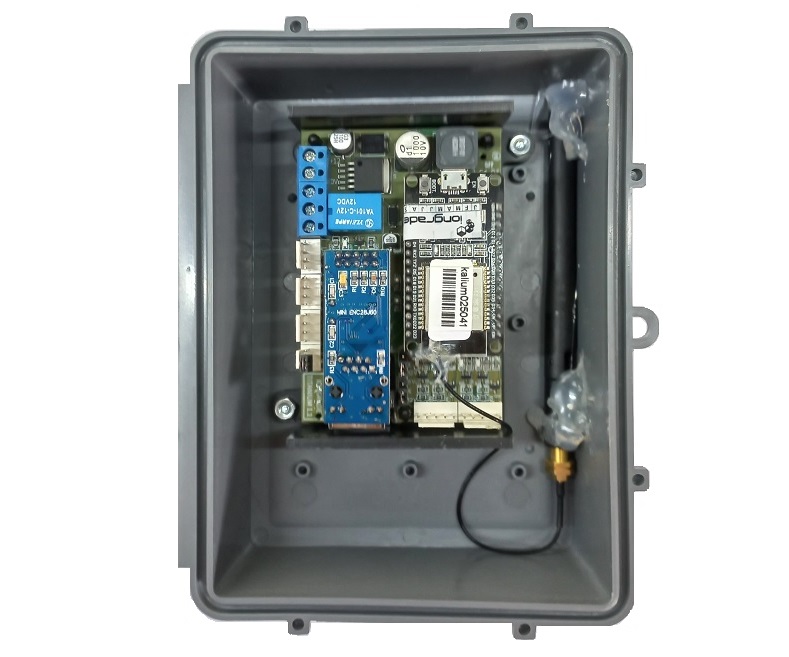
The Kalium connects to the management system through an Ethernet (RJ45) communication network, with GSM available as a communication option. In parallel, it acts as the main node of a mesh network formed by the Scandium antennas.
It has a highly accurate internal clock and can be configured to access an external NTP server. It also has an embedded HTTP server, through which all configuration is done using a web browser. It is powered by 12 VDC.
Integration with several market software packages is possible through the OpenION protocol or through customizations for specific purposes.
Mesh System Architecture
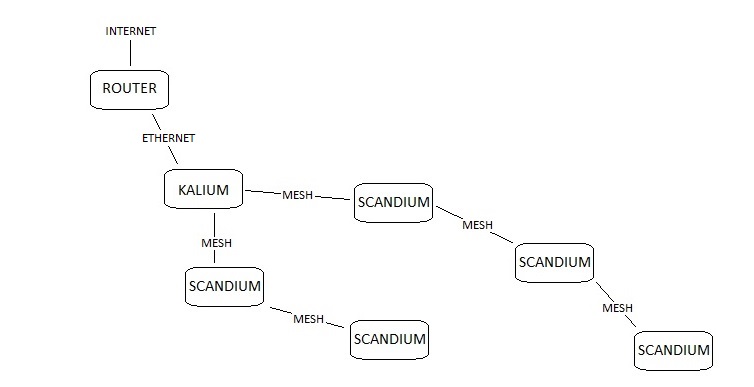
The Iongrade BLE system is made up of two devices that operate together: the Kalium gateway and the Scandium antennas. The complete topology is as follows:
Internet ── Router ── Kalium (root node) ── mesh network ── Scandium × N
                                                              │
                                                            beacons
The Kalium gateway communicates via Ethernet with a router to access the internet and, on the other side, communicates through a mesh network with the Scandium antennas. On the mesh network, the Kalium is the root node, while the Scandium antennas are the non-root nodes.
The mesh network is a network protocol built on top of the Wi-Fi protocol. It allows several devices spread across a large physical area — both indoors and outdoors — to be interconnected in a single WLAN (wireless local area network). The mesh network is self-organizing and automatically readapts dynamically, which means nodes can be added or removed autonomously.
Detection Flow
The Scandium antennas detect the beacons present in their coverage area and report this information, over the mesh network, to the Kalium gateway, which in turn forwards the information to the system server:
- The beacon emits its BLE signal.
- The Scandium detects the beacon in its coverage area.
- The information travels over the mesh network to the Kalium.
- The Kalium forwards the data to the system server (via MQTT, over the Ethernet/internet connection).
Each node of the mesh network must be configured so that it can join the network. You can configure the characteristics of the beacons the system should work with, so that beacons that are not part of the system are ignored. You can also specify beacons that signal alarm/panic situations, which when detected trigger the alarm relay on the Kalium gateway.
Communication between the Kalium and the system server uses the MQTT protocol. The broker parameters (Accelero Cloud or a custom broker) are documented separately.
Supported Beacons
A beacon is a device that uses Bluetooth Low Energy (BLE) technology. Beacons emit an intermittent radio wave signal that can be detected by special detection techniques.
There are several types of beacons with different technologies, and the Kalium/Scandium solution is ready to work with the most important ones:
| Beacon | Technology |
|---|---|
| iBeacon | Apple |
| Eddystone | |
| AltBeacon | Open Source (several manufacturers) |
Choosing the beacon type and its characteristics is an important step to get the best result in each project.
Applications
The Kalium gateway can be used in beacon monitoring for:
- Monitoring and location tracking of people and assets
- Panic buttons (wireless)
- Occupancy control of environments
- Presence control in classified industrial environments (Red Zone)
- Personnel evacuation control (Green Zone)
Technical Specifications
| Specification | Value |
|---|---|
| Type | BLE communication gateway |
| Role in the network | Root node of the mesh network |
| Power supply | 12 VDC ±5% |
| Consumption | up to 700 mA |
| Network communication | Ethernet (RJ45); GSM as an option |
| Detection network | Mesh over Wi-Fi (self-organizing) |
| Supported antennas | Up to 8 Scandium antennas |
| Supported beacons | iBeacon (Apple), Eddystone (Google), AltBeacon |
| Alarm relay | Triggered when a beacon flagged as alarm is detected (1A/120VAC or 2A/30VDC) |
| Server protocol | MQTT (Accelero Cloud or custom broker) |
| Connectivity | OpenION or customizations |
| Configuration server | Embedded HTTP, accessible through a web browser |
| Clock/calendar | Precision internal clock, with optional synchronization via an external NTP server |
Next Steps
- Installation Manual — power supply, alarm relay, buttons, and LEDs