Neon Access Controller
The Neon access controller features the most modern technological resources to offer the best cost/benefit ratio in access control system projects.
Overview
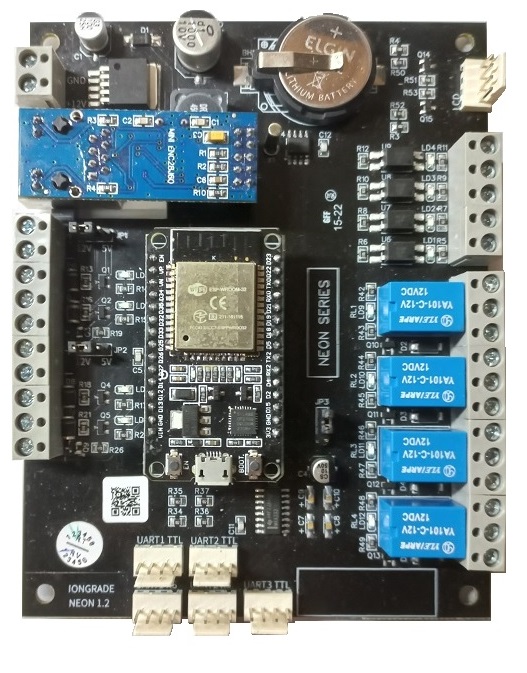
Designed to operate with IoT communication protocols, Neon allows easy integration with a wide variety of access control systems.
The hardware was engineered to operate safely and reliably under the most diverse environmental conditions. It features specially designed electronic circuits to protect components against electrical discharges. The signal inputs are built with optical couplers that fully isolate the sensors from the controller's internal circuits.
It can connect to the communication network using wireless technology (WiFi) or through a 10/100-Base-T Ethernet UTP cable. It has a highly accurate internal clock and can be configured to access an external NTP server.
The controller has an internal HTTP server and is configured through a browser. It has interfaces for two card readers, serial ports, and a display connection. It accepts ABATrack/Wiegand readers, QR Code scanners, a Bluetooth module, and an audio module. It is powered by 12VDC.
It is prepared to control turnstiles, one or two doors, and airlock-type gates — the control mode is configurable.
Neon accepts the connection of up to three readers: two ABATrack/Wiegand readers connected directly to the reader interfaces and a third reader added via UART3 with the IODINE module — a typical application in turnstiles with a visitor card collection bin. See the Third Reader page.
The controller also maintains a local contingency list of up to 100,000 users, allowing access decisions to be made even when communication with the server fails.
Key Features
- IoT Connectivity: WiFi (Wireless) or Ethernet 10/100-Base-T (RJ45)
- Up to three readers: two ABATrack/Wiegand readers + a third reader via UART3 (IODINE module)
- Serial ports (UARTs): for QR Code scanners, Bluetooth modules, biometrics, etc.
- Local contingency list: up to 100,000 users stored in the controller's memory
- Four command relays: LOCK1, LOCK2, ALRM1, ALRM2
- LCD display: I2C connection for display module
- Internal clock: high precision with NTP server support
- Internal HTTP server: configuration via web browser
- Power supply: 12VDC
Technical Specifications
| Specification | Value |
|---|---|
| Power supply | 12 VDC ±5% |
| Consumption | ≈120 mA (board, without peripherals) / up to 350 mA (nominal with modules) |
| Network connection | WiFi or Ethernet 10/100-Base-T |
| Card readers | 2x (ABATrack/Wiegand) + 1 additional reader via UART3 (IODINE module) |
| Serial ports | 3x UARTs (UART1 and UART2 configurable, TTL 5V/RS232; UART3 TTL 3.3V) |
| Output relays | 4x (1A/120VAC or 2A/30VDC) |
| Signal inputs | REX1, REX2, PAS/DOOR1, PAS/DOOR2 |
| Display | LCD I2C (5VDC) |
| Reader voltage | selectable 5VDC or 12VDC (jumper) |
Operation Modes
The Neon controller is prepared to control several types of devices. The mode is defined on the Acesso → Bloqueio (Access → Lock) screen (see the Operation Manual):
- Turnstile with unidirectional readers: entry reader, exit reader, and collection bin
- Turnstile with bidirectional reader: bidirectional reader + collection bin
- Single door: reader on entry and exit
- Two doors with unidirectional readers: control of two independent doors
- Two interlocked doors (airlock): one door opens only if the other is closed
- Interlocked combo door: airlock with external signal
- Two barriers with automatic passage
- Delayed lock: door with opening time delay
- Logger: passage logging only, without control
Channels and Ports Concept
The Neon controller operates with the concept of channels and ports.
Channels
The controller has two control channels. A user can be enabled for access on each channel independently. The two card readers are directly associated with channels 1 and 2.
| Channel | Signal Inputs | Relays |
|---|---|---|
| Channel 1 | REX1, PAS/DOOR1 | LOCK1, ALRM1 |
| Channel 2 | REX2, PAS/DOOR2 | LOCK2, ALRM2 |
Ports
The Port concept controls the entry of user identifiers. Each port represents a possible identification source on each channel:
| Port | Channel 1 | Channel 2 |
|---|---|---|
| 1 | Reader 1 | Reader 2 |
| 2 | UART 1 | UART 2 |
| 3 | Web 1 | Web 2 |
| 4 | MQTT 1 | MQTT 2 |
| 5 | QR Code 1 | QR Code 2 |
This way, the control software can enable/disable a user on specific ports/channels according to need.
Examples:
- A user can be enabled to pass through a channel exclusively using QR Code identification.
- A user can be enabled to pass through a channel using a proximity card or a Bluetooth reader connected to the channel's UART.
Compatibility
The Neon controller is compatible with:
- Accelero system
- Wiegand protocol (26-bit standard and other formats)
- ABATrack protocol
- QR Code scanners
- Bluetooth modules
- Biometric readers
- MQTT protocol
- UDP communication
Next Steps
- Installation Manual — electrical connections and physical installation
- Operation Manual — equipment configuration and operation
- Third Reader — adding a third reader via UART3 and the IODINE module