Scandium BLE Antenna
Scandium has been discontinued and is no longer sold for new projects. This documentation remains available to support existing installations. For new projects or replacements, contact the Iongrade sales team.
Scandium is a beacon detection antenna for monitoring systems based on Bluetooth Low Energy (BLE). It detects the beacons present in its coverage area and reports that information to the Kalium gateway over a mesh network.
Designed for the best cost/benefit ratio in beacon monitoring projects, Scandium operates with IoT communication protocols, which makes it easy to integrate with a wide range of asset management systems and systems for monitoring people, animals, and vehicles.
Scandium does not communicate with the internet or with the system server. It only detects beacons in its area and reports them to Kalium over the mesh network. It is the Kalium gateway that consolidates the information from all antennas and forwards it to the server.
Overview
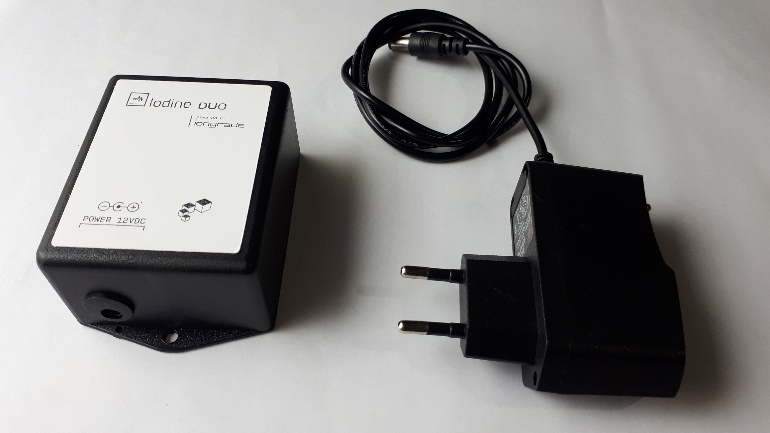
The Scandium antenna combines modern technology resources and is designed to operate safely and reliably in a wide range of environmental conditions. The hardware includes electronic circuits specifically designed to protect the components against electrical discharges.
Configuration is done through an embedded HTTP server, accessible from a web browser. The antenna is powered by 5 VDC.
Role in the Mesh System
A beacon is a device that uses Bluetooth Low Energy (BLE) technology and emits an intermittent radio wave signal. Scandium detects that signal and, over the mesh network, reports the beacon's presence to the Kalium gateway.
In the mesh network, Kalium is the root node and the Scandium antennas are the secondary nodes (non-root nodes). The network is self-organizing: each antenna can eventually serve as a route for the others, and nodes can be added or removed autonomously, without manual reconfiguration of the topology.
Scandium receives the operating parameters from the gateway — such as report cycle, retention, and detection sensitivity — and returns, over the mesh, the beacons detected in its area.
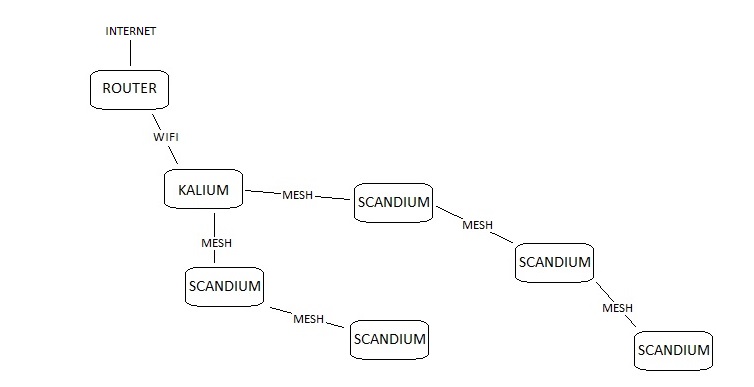
To understand the complete system architecture — the role of the gateway, communication with the server, and relay activation — see the Kalium Overview.
Supported Beacons
There are several types of beacons, based on different technologies. The Kalium/Scandium solution is ready to operate with the most important ones:
| Technology | Origin |
|---|---|
| iBeacon | Apple technology |
| Eddystone | Google technology |
| AltBeacon | Open source, created by other manufacturers |
You can configure the characteristics of the beacons the system should operate with, so that it ignores beacons that are not part of the system. You can also specify beacons that signal alarm/panic situations, which when detected trigger commands to activate relays on Kalium.
Choosing the beacon type and its characteristics is an important step to achieve the best result in each project.
Applications
The Scandium antenna is used for beacon detection and can be applied to:
- Monitoring and locating people and assets
- Panic buttons (wireless)
- Occupancy control of environments
- Presence control in classified industrial environments (Red Zone)
- Personnel evacuation control (Green Zone)
Technical Specifications
| Specification | Value |
|---|---|
| Type | BLE beacon detection antenna |
| Network role | Secondary node (non-root) of the Kalium mesh network |
| Communication | Mesh network built over Wi-Fi |
| Topology | Self-organizing — each antenna can serve as a route for the others |
| Supported beacons | iBeacon, Eddystone, AltBeacon |
| Detection sensitivity | Adjustable (in meters) |
| System capacity | Up to 8 Scandium antennas per Kalium gateway |
| Configuration | Embedded HTTP server, accessible from a web browser |
| Power supply | 5 VDC |
| Version | 1.5 (firmware 1.0.8) |
Next Steps
- Installation and Configuration — power supply, activating configuration mode with a magnet, and the configuration web screens
- Kalium Overview — complete architecture of the beacon mesh system