ZKTeco Integration
The integration with ZKTeco devices enables the use of facial recognition equipment in ACCELERO access control.
This feature requires the ZKTeco module enabled in the license. See Licensing.
Overview
The ZKTeco integration offers:
| Feature | Description |
|---|---|
| Facial Recognition | Automatic synchronization of facial templates to ZKTeco devices |
| Automatic Removal | Automatic deletion of visitor templates after exit |
| Communication Status | Real-time monitoring of communication with devices |
The integration is done through an ACCELERO/ZKTECO communication gateway (IONGRADE product). The gateway bridges the ACCELERO servers and the ZKTeco devices.
Navigation path: Advanced > System > Integrations - ZKTeco
Homologated models
| Type | Model | Integration mode |
|---|---|---|
| Facial | Speed Face V4 | Neon Controller |
Explanation of the modes (Direct × Neon Controller) and the complete matrix in Homologated Equipment.
Architecture and Requirements
The integration with ZKTeco devices uses:
- ACCELERO/ZKTECO Gateway (IONGRADE product)
- ZKTeco Devices for facial recognition
- ACCELERO Server with the module enabled
Data flow:
ACCELERO → Gateway → ZKTeco Devices
        ← Status ←
Currently, only the "Facial" function is available in the ZKTeco integration.
General Settings
Path: Advanced > System > Integrations - ZKTeco > Settings
Main Parameters
| Field | Description |
|---|---|
| Type | Device model (currently only "Facial" available) |
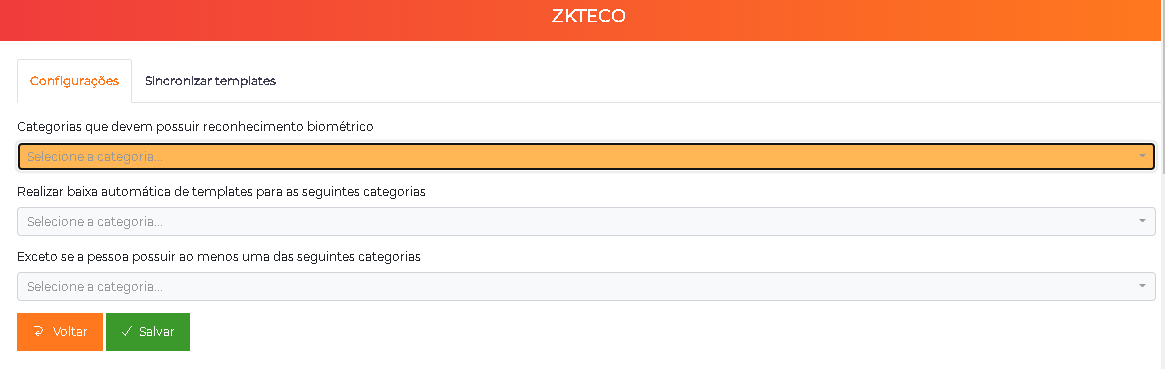
| Categories that must have facial recognition | Defines which categories will have facial templates generated and distributed. Example: disable for temporary visitors |
| Automatically remove templates for the following categories | Categories whose templates are automatically deleted after passing through controllers with "Automatic visitor removal" |
Automatic template removal is essential to avoid fully occupying the memory of the ZKTeco devices, especially in systems with high visitor traffic.
How to set up the categories: after registering the gateway and devices, go to Advanced > System and navigate to the Integrations - ZKTeco submenu. Define, according to the client's needs, which categories use facial recognition and which undergo automatic template removal.
Communication Status
The Settings tab also displays:
- Communication status with the gateway
- Communication status with each ZKTeco device individually
This view allows you to quickly identify connection problems.
Periodically check the communication status to identify and resolve problems before they affect the operation.
Registering Gateways
The gateway is the concentrator of the integration: it receives the registrations from the ACCELERO server and distributes them to all the facial readers pointed to it. Always start with the gateway configuration, since it is the one that manages the devices.
Before registering, make sure the gateway is connected to the internet network and to the power supply.
For the ZKTeco integration, it is mandatory to fix the gateway IP (static IP). Without this, the communication of the devices does not occur correctly.
Step by step:
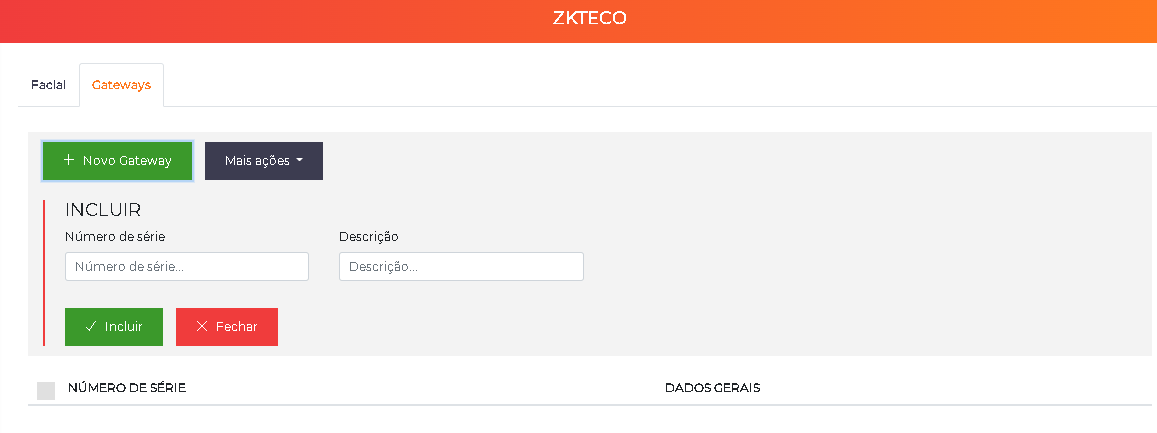
- Go to the
Settings > ZKTecomenu and select the Gateways submenu. - Click the option to add a new gateway.
- Fill in the fields below and save.
| Field | Description |
|---|---|
| Serial number | Serial number of the gateway, available on the label of the physical equipment. CRITICAL: The information must be correct or communication will fail |
| Description | Name/description of the gateway, at the client's choice |
Registering Devices
With the gateway configured, register the facial readers.
Step by step:
- Go to the
Settings > ZKTecomenu and open the Devices submenu. - Click the option to add a new device.
- Fill in the fields below and save.
| Field | Description |
|---|---|
| Type | Currently, only the "Facial" function is available |
| Description | Name/location of the device |
| Serial number | Serial number of the equipment. ⚠️ CRITICAL: Used as the "key" to recognize the equipment |
| Gateway | Gateway configured in the previous step, to which the device is subordinate |
| Active | If disabled, the device will not receive registration/deletion commands |
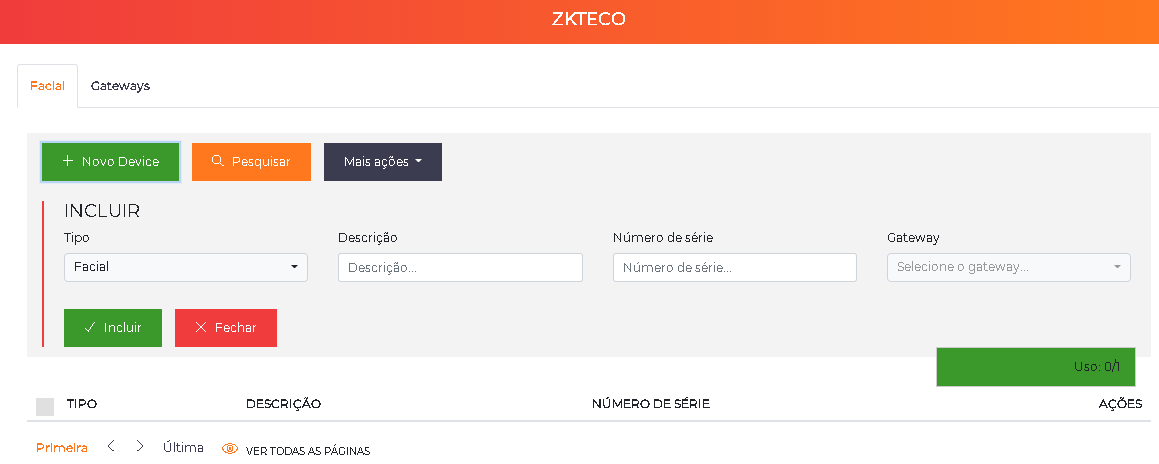
Unlike Hikvision/Beward, the ZKTeco facial reader is identified only by the serial number — there are no IP, port, or credential fields in the device registration. The static IP is configured on the gateway, not on the reader.
Always check the physical connections of the equipment — power, network, and the Wiegand connections on the desired controller — before putting the reader into operation.
The "Serial number" field is of extreme importance because it is used as the key to identify the equipment.
Make sure that:
- The serial number is correct
- It matches the physical serial number of the equipment
- There are no duplicates in the system
Incorrect serial number = total communication failure.
The ZKTeco integration is simpler than Hikvision/Dahua/Control iD:
- No IP/port configuration per device
- No user/password credentials
- Identification based on serial number only
The gateway manages the communication with the devices automatically.
Include a screenshot of the device registration screen showing all fields.
How Synchronization Works
Automatic Synchronization
After the settings, synchronization happens automatically:
-
When saving a person's registration:
- The system checks whether the person has a category configured for facial recognition
- If so, it generates a template from the first photo of the registration
- It distributes the template to all active devices
-
Visual indicators on the photo:
- 🔴 Red icon: Templates not yet fully distributed
- 🔵🔵 Two blue icons: Templates distributed successfully
The first photo of the registration is always used for synchronization. Make sure:
- ✓ Good capture quality
- ✓ Good lighting
- ✓ Frontal framing of the person
- ✓ Neutral background (if possible)
Manual Synchronization (Full Resend)
Path: Advanced > System > Integrations - ZKTeco > Settings
When to use:
- Replacing a device in the field
- Restoring after a severe failure
- Bulk update of all templates
How to do it:
- Go to the Settings tab
- Click the Send full list button
- Wait for completion (it can take considerable time)
In the ZKTeco integration, the resend is done through the "Send full list" button on the Settings tab, instead of a separate "Synchronize templates" tab as in Hikvision/Dahua/Control iD.
The send time depends on the number of photos. For large systems (thousands of people), the process can take hours.
During the process:
- Do not turn off the ACCELERO server
- Do not restart the gateway
- Monitor the communication status
Include a screenshot of the Settings tab showing the "Send full list" button.
Automatic Visitor Removal
ACCELERO can automatically delete visitor templates after their exit.
When the deletion occurs:
-
When passing through a barrier with the "Remove visitors" flag:
- The system checks whether the person has a category from the "Automatically remove" list
- If the conditions are met, it deletes the template from the devices
-
When closing/deleting an event:
- The same check above is performed
- Templates are removed automatically
Configuration example:
Automatically remove: VISITORS, CONTRACTORS

Result:
- Visitor: template will be deleted after exit ✓
- Employee: template kept (not on the list) ✗
The ZKTeco integration does not have the "Except if the person has..." filter.
Removal is done based only on the list of configured categories, making the configuration simpler.
Automatic removal is essential to:
- Avoid exhausting device memory
- Keep only active registrations
- Ensure facial recognition performance
Best Practices
Planning
-
Define categories before configuring:
- Which categories will have facial recognition?
- Which categories will have automatic removal?
-
Size the device memory:
- Check the template capacity per device
- Plan the automatic removal policy
- Monitor memory usage
-
Document serial numbers:
- Note the serial numbers of all devices
- Keep the list updated
- It makes maintenance and replacement easier
Operation
-
Photo quality:
- Train operators on the importance of the first photo
- Use adequate lighting
- Always frontal framing
- Preferably a neutral background
-
Monitor synchronization:
- Check the status icons on the photos
- Investigate synchronization failures quickly
- Use "Send full list" only when necessary
-
Manage memory:
- Enable automatic removal for visitors
- Configure the correct categories
- Monitor device memory usage
-
Track communication status:
- Regularly check the status on the Settings tab
- Identify offline devices
- Resolve network problems promptly
Maintenance
-
Check communication status:
- Gateway ↔ ACCELERO
- Gateway ↔ Devices
- Resolve network problems quickly
-
Back up before changes:
- Back up before reconfiguring gateways
- Document configuration changes
- Test after changes
-
Device replacement:
- Note the serial number of the new device
- Update the registration in ACCELERO with the new serial number
- Use "Send full list" to synchronize
- Test recognition after replacement
-
Firmware updates:
- Consult IONGRADE before updating ZKTeco firmware
- Check compatibility
- Test in a controlled environment first
Troubleshooting
Templates do not synchronize
Possible causes:
- Gateway without communication with ACCELERO
- Gateway without communication with the device
- Device marked as inactive
- Person without a category configured for facial recognition
- Incorrect serial number
Solution:
- Check the communication status on the Settings tab
- Confirm that the device is active
- Check whether the person has the correct category
- Confirm that the serial number is correct (most common cause!)
- Use "Send full list" if necessary
Device appears offline
Possible causes:
- Network problem
- Device powered off
- Incorrect serial number in the registration
- Gateway without communication with ACCELERO
Solution:
- Check whether the device is powered on and on the network
- Test a ping to the device IP
- Confirm the serial number in the registration vs the physical equipment
- Check the gateway status
- Restart the gateway if necessary
Full list send fails
Possible causes:
- Too many offline devices
- Memory problems on the devices
- Overloaded gateway
Solution:
- Check the status of all devices
- Fix offline devices before trying again
- Consider sending during low system usage hours
- Check the gateway logs
Device memory full
Solution:
- Enable "Automatic template removal"
- Configure the correct categories
- Use "Send full list" to clear and re-synchronize
- Perform manual cleanup via the ZKTeco interface (if available)
- Consider increasing memory capacity (hardware)
Facial recognition fails
Possible causes:
- Poor photo quality
- Template not synchronized
- Device memory full
- Inadequate lighting at the location
Solution:
- Check the status icons on the person's photo
- Recapture the photo with better quality
- Check the device memory usage
- Improve lighting at the reading location
- Use "Send full list" if necessary
Comparison with Other Integrations
ZKTeco vs Hikvision/Dahua
| Feature | ZKTeco | Hikvision/Dahua |
|---|---|---|
| Device configuration | Serial number only | IP, port, user, password |
| Template resend | "Send full list" button | Separate "Synchronize templates" tab |
| Automatic removal | Category list only | List + exceptions |
| Available types | Facial only | Facial + LPR |
| Photo capture | Not available | Available (Hikvision) |
| Complexity | ⭐ Low | ⭐⭐⭐ Medium |
-
Advantages:
- Simpler configuration
- Fewer parameters to manage
- Good cost-benefit ratio
-
Disadvantages:
- Facial recognition only (no LPR)
- No integrated photo capture
- Fewer advanced features
Ideal for projects that need only basic facial recognition without additional complexity.
Next Steps
- Categories - Configure categories for facial recognition
- People - Register photos for facial recognition
- Controllers - Configure physical controllers
- Licensing - Check available modules
- Hikvision - Compare with other integrations
- Control iD - Alternative with more features