Regulatory Compliance
ION Guard Cold Room was designed to support compliance with the Brazilian regulatory standards that address occupational exposure to cold. This document maps each regulatory requirement to the corresponding mechanism in the system.
ION Guard is a support tool for complying with the regulatory standards. It does not replace the company's Occupational Health and Safety (OHS) management program, the ergonomic assessment, or the work of the SESMT. Responsibility for complying with the NRs remains with the employer.
NR-15 — Unhealthy Activities and Operations (Annex 9)
What the standard says
Regulatory Standard 15, in its Annex 9, sets the tolerance limits for occupational exposure to cold. The standard establishes that work in environments with artificially reduced temperatures constitutes an unhealthy activity and that the worker must have thermal recovery periods proportional to the intensity of the cold.
Annex 9 classifies exposure to cold according to the environment temperature:
- 0°C to -17.9°C — medium-degree unhealthiness
- Below -18°C — maximum-degree unhealthiness
For each range, limits for continuous dwell time and minimum recovery intervals are defined.
Table of implemented regimes
The system implements three regime ranges, combining the criteria of NR-15 Annex 9 with the intervals of CLT Art. 253:
| Temperature range | Maximum continuous exposure | Minimum break | Degree of unhealthiness |
|---|---|---|---|
| 0.0°C to -17.9°C | 100 minutes (1h40) | 20 minutes | Medium |
| -18.0°C to -27.9°C | 80 minutes (1h20) | 20 minutes | Maximum |
| -28.0°C to -80.0°C | 60 minutes (1h00) | 30 minutes | Maximum |
NR-15, Annex 9 — Tolerance limits for exposure to cold. Default values configurable by the administrator according to the company's ergonomic assessment.
How the system implements it
- Automatic timer per session — when the worker's beacon is detected in a cold room zone, the system automatically starts counting the continuous exposure time
- Temperature-based regime — the system automatically selects the applicable regime based on the zone's declared temperature
- Progressive alerts — upon reaching the configured percentages of the limit (default: 75%, 90%, and 100%), the system triggers visual and audible alerts
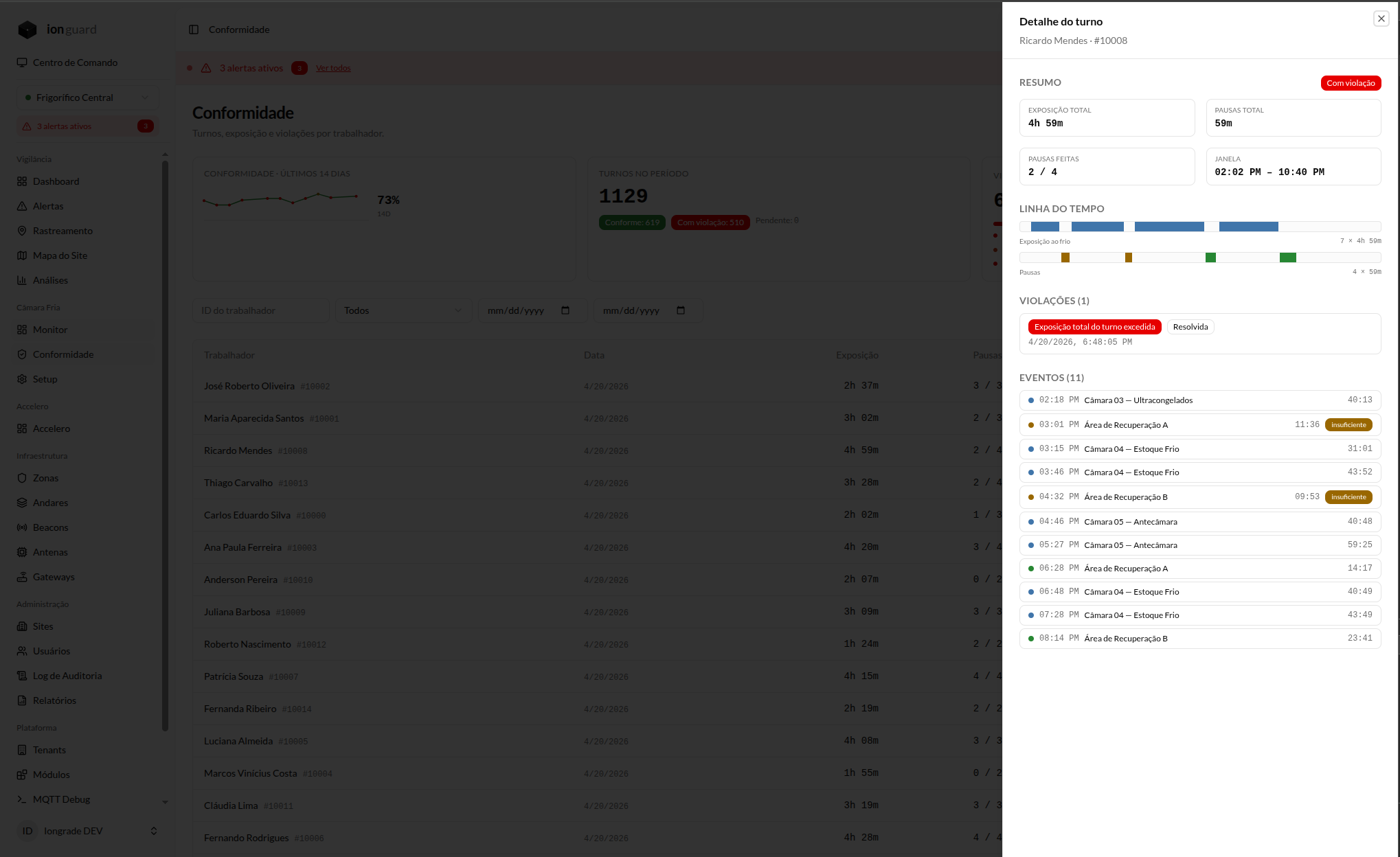
- Violation record — upon reaching 100% of the limit, a Continuous Exposure Exceeded violation is recorded automatically
NR-15 violations
| Violation type | Description | When it occurs |
|---|---|---|
| Continuous Exposure Exceeded | The worker stayed in the cold room beyond the regime's continuous limit | Timer reaches 100% of the limit |
| Insufficient Break | The worker took a break in the recovery area, but shorter than the required minimum | Break ended before the minimum time |
| Break Not Taken | The worker returned to the cold room without going through the recovery area | Entry into the room without a prior break |
CLT Art. 253 — Intervals for Thermal Recovery
What the law says
Article 253 of the Consolidation of Labor Laws (CLT) establishes that:
"For employees who work inside cold storage rooms and for those who move goods from a warm or normal environment to a cold one and vice versa, after 1 (one) hour and 40 (forty) minutes of continuous work, a 20 (twenty)-minute rest period shall be guaranteed, this interval being counted as effective work time."
How the system implements it
CLT Art. 253 is the basis for the most common default regime: 100 minutes of continuous work + 20 minutes of break. In the system:
- The default value of
minBreakSecondsis 1,200 seconds (20 minutes), corresponding exactly to the interval required by Art. 253 - The break is considered "taken" only when the worker stays outside the cold room (in a recovery zone) for a time equal to or greater than the minimum
- If the worker returns to the room before completing the break, the system records the break as insufficient
NR-36 — Safety and Health in Meatpacking Plants
What the standard says
Regulatory Standard 36 deals specifically with occupational safety and health in companies that slaughter and process meat and derivatives. The items relevant to cold room monitoring are 36.7 (thermal breaks per shift) and 36.12 (cold room requirements).
Although NR-36 formally applies to meatpacking and slaughtering companies, many refrigerated logistics and cold storage operations adopt its criteria as a best-practice reference. ION Guard implements the rules regardless of the company's industry — it is up to the SESMT to determine applicability.
Item 36.7 — Accumulated thermal breaks per shift
Item 36.7 of NR-36 establishes that workers exposed to cold must have cumulative thermal breaks proportional to the shift duration:
| Shift duration | Minimum accumulated break | Reference |
|---|---|---|
| Up to 6h00 | 20 minutes | NR-36, item 36.7 |
| 6h01 to 7h20 | 45 minutes | NR-36, item 36.7 |
| 7h21 to 8h48 | 60 minutes | NR-36, item 36.7 |
| Over 8h48 | 60 minutes + proportional | NR-36, item 36.7 |
How the system implements it:
- Daily consolidation — an automatic process runs daily (at 02:00) and evaluates each shift from the previous day
- NR-36 validation — for each worker, the system sums the total time of breaks taken during the shift and compares it with the minimum required for the shift duration
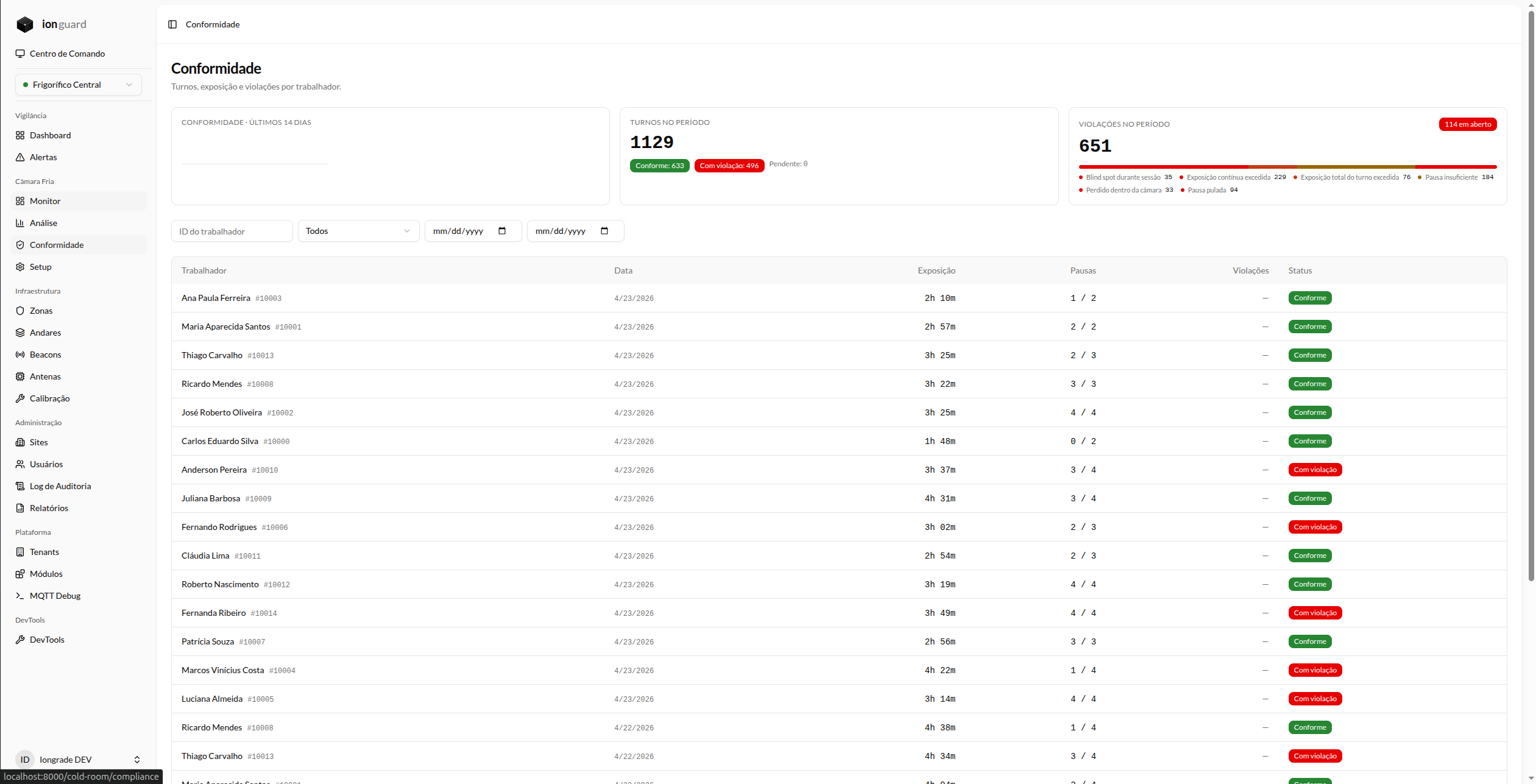
- Shift total violation — if the total breaks were less than the minimum, a Shift Total Exceeded violation is recorded
| Violation type | Description | When it occurs |
|---|---|---|
| Shift Total Exceeded | The total breaks taken during the shift were less than the minimum required by NR-36 for the shift duration | Daily consolidation detects insufficiency |
Items 36.12.1 to 36.12.4 — Cold room requirements
NR-36 establishes specific requirements for cold rooms with a temperature at or below -18°C:
| NR-36 requirement | What it requires | How ION Guard meets it |
|---|---|---|
| 36.12.1 | Indication of the maximum dwell time | Timer visible on the dashboard and wallboard in real time |
| 36.12.2 | Device that allows the doors to be opened from the inside | Physical requirement (out of software scope). The portable BLE panic button complements it as an emergency alarm |
| 36.12.3 | Alarm or communication system operable from the inside | BLE panic button — instant alert with precise "inside the cold room" location |
| 36.12.4 | Thermal recovery breaks in accordance with item 36.7 | Automatic break monitoring with alerts when a break is due |
Operational safety violations
In addition to the regulatory violations above, the system records two operational safety violations — not provided for in the standards, but essential to avoid losing sight of workers inside the cold room:
| Violation type | Description | When it occurs |
|---|---|---|
| Cold Room Signal Lost | The beacon signal was lost while the worker was in the room | Beacon with no signal for more than 2 minutes |
| Blind Spot During Session | An antenna went offline while there were active sessions in the room | Antenna with no heartbeat for more than 2 minutes |
These situations also trigger the Cold Room Blind Spot alert (see Alerts). The complete list of the 6 violation types is in Compliance and Shifts.
Cross-compliance matrix
A consolidated view of how each regulatory requirement is met by the system:
| Regulatory requirement | System mechanism | Violation generated | Evidence produced |
|---|---|---|---|
| Continuous exposure limit (NR-15 Annex 9) | Automatic timer per session with temperature-based regime | Continuous Exposure Exceeded | Session with entry/exit timestamps and duration |
| Minimum break between exposures (NR-15 / CLT Art. 253) | Validation of break duration in the recovery area | Insufficient Break / Break Not Taken | Break with recorded duration and sufficiency flag |
| Accumulated breaks per shift (NR-36 item 36.7) | Daily consolidation with validation of total breaks | Shift Total Exceeded | Shift with exposure and break totals |
| Indication of maximum time (NR-36 item 36.12.1) | Full-screen wallboard at the room entrance | — | Continuous real-time display |
| Alarm operable from the inside (NR-36 item 36.12.3) | Portable BLE panic button | — | Alert with location and timestamp |
| Exposure records (all NRs) | Immutable log of sessions, breaks, and violations | — | Report with SHA-256 hash and chaining |
Integrity and evidentiary value of the records
ION Guard implements integrity mechanisms that give the records evidentiary value for labor auditing purposes:
SHA-256 hash
Each report generated by the system includes a SHA-256 hash of its content. This hash is a "fingerprint" of the document — any change, however small, results in a completely different hash.
Report chaining
Each new report stores the hash of the previous report, forming an integrity chain. If any intermediate report is altered, the chain breaks and verification fails. This mechanism is similar to the one used in blockchains and ensures that the records were not tampered with.
Immutable records
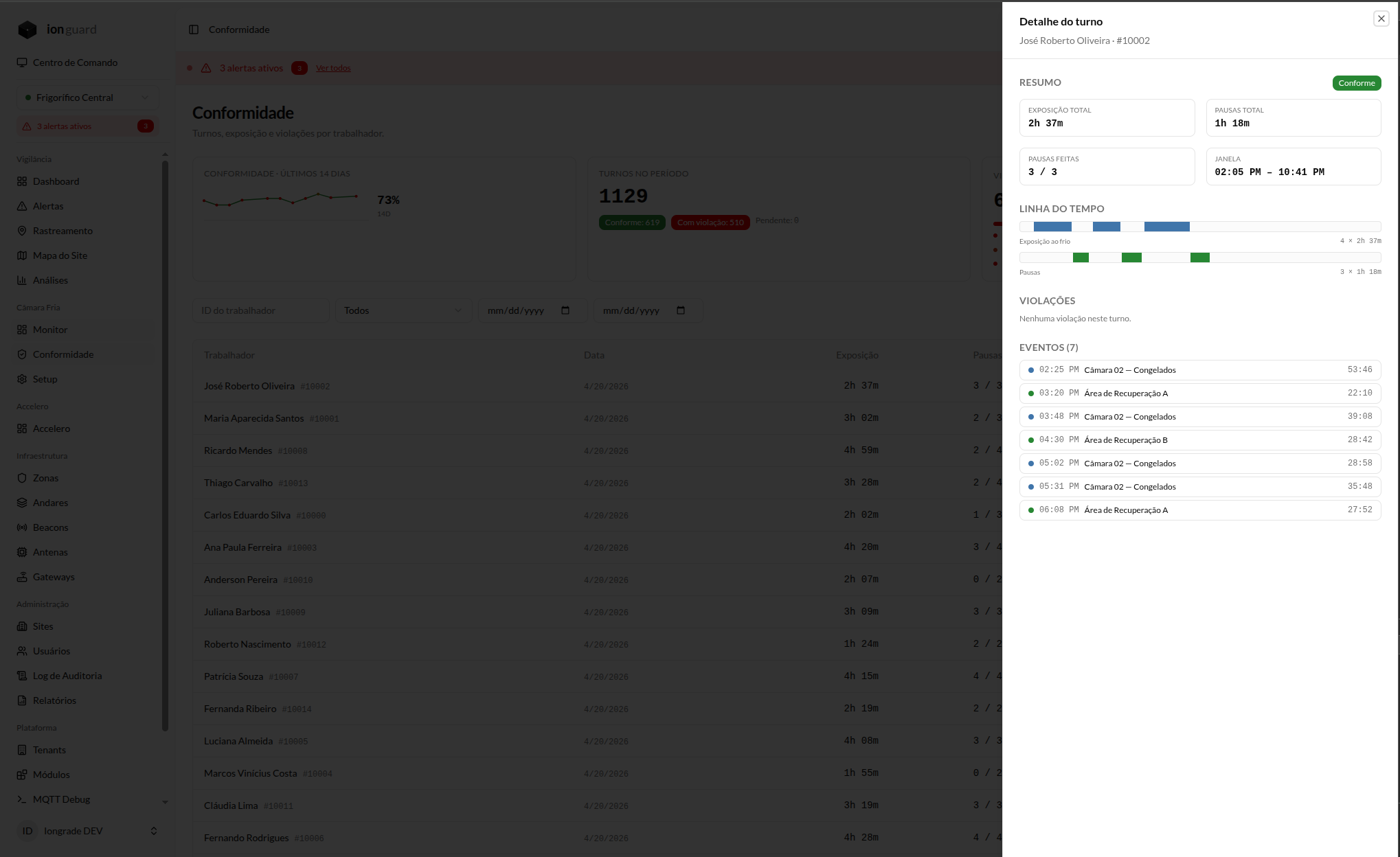
Violations, sessions, and breaks are recorded in append-only mode — once created, they cannot be edited or deleted. Violations can be resolved (with an explanatory note and identification of the responsible person), but the original record remains intact for auditing.
Integrity verification
The system offers an integrity verification feature: the administrator can request the recomputation of any report's hash and compare it with the stored hash. If the values differ, this indicates that the report was tampered with.
Limitations and responsibilities
ION Guard Cold Room is a technological tool that supports compliance with the regulatory standards. It does not replace:
- The company's Risk Management Program (PGR)
- The ergonomic assessment of the work environment
- The work of the SESMT (Specialized Service in Occupational Safety Engineering and Occupational Medicine)
- Worker training on risks and procedures
Declared temperature
In the current version, each zone's temperature is declared by the administrator during configuration — the system does not measure temperature via sensor. It is recommended that the configured temperature be validated periodically against real measurements.
Shift inference
When the system is not integrated with an electronic time clock, the shift boundaries are inferred automatically based on the worker's activity (the day's first and last activity, with a 30-minute inactivity timeout). This inference may differ from the worker's actual shift.
Periodic auditing
It is recommended that the administrator periodically review:
- The declared temperatures in the zones
- The configured exposure regimes
- The beacon assignments to workers
- The registered work schedule of each worker (used for the NR-36 calculation)